BC Road Signs Test: Most Common Signs on the ICBC Knowledge Test
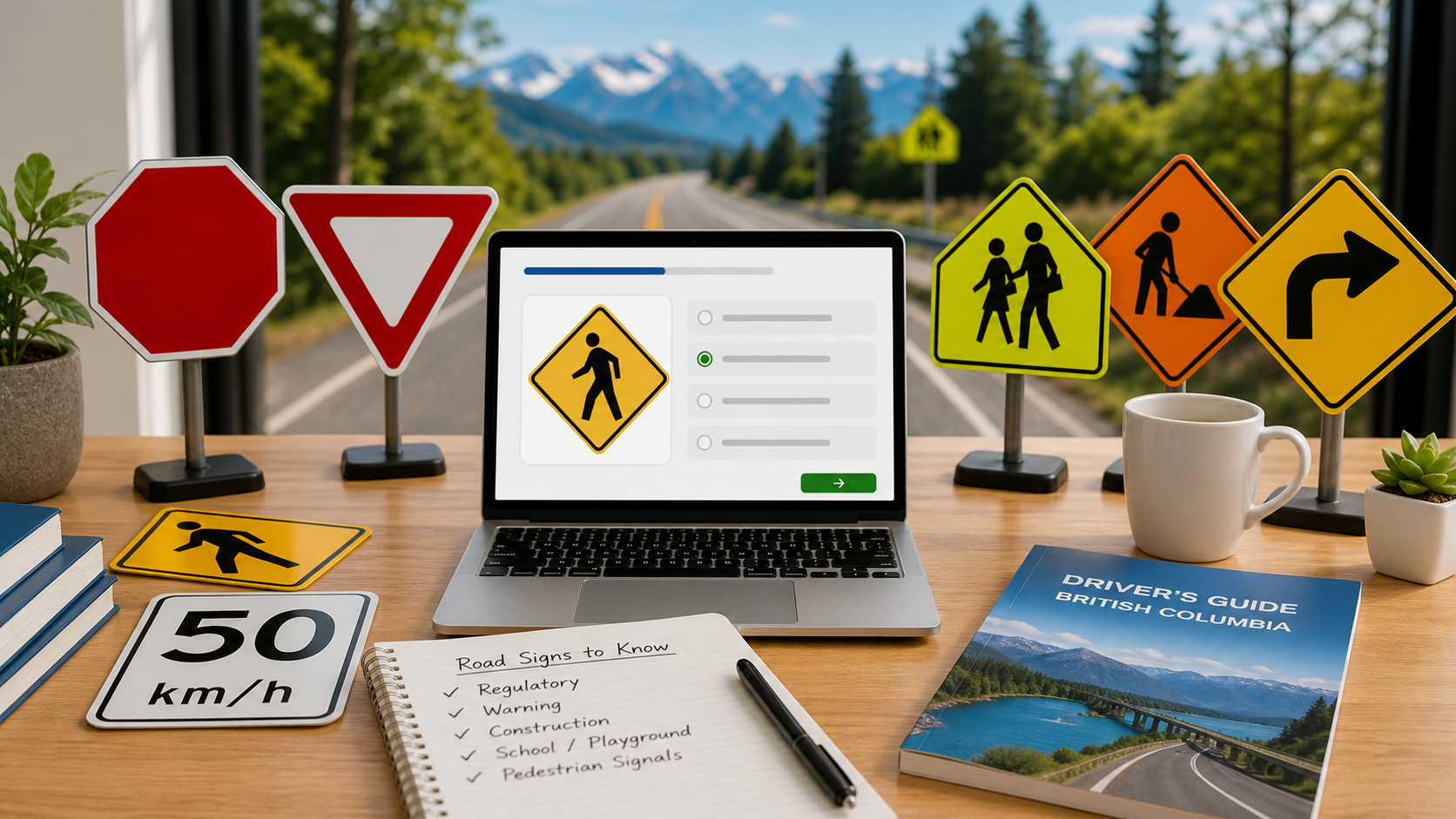
BC road signs are one of the easiest areas to improve before the ICBC knowledge test. Many learners lose marks because they recognize a sign but cannot explain what action it requires. The test may ask what a sign means, what you should do next, or what hazard you should expect.
Study signs by category, not one at a time. Categories help you understand the purpose of the sign before you memorize details.
Regulatory signs
Regulatory signs tell drivers what they must or must not do. These signs are usually enforceable and often use clear shapes and colors. Examples include stop, yield, speed limit, no entry, no left turn, no right turn, keep right, one way, and do not pass.
For the test, remember that regulatory signs usually require a specific legal action.
Warning signs
Warning signs alert you to hazards ahead. They are often yellow and diamond-shaped. Examples include curve ahead, winding road, slippery road, pedestrian crossing, school zone, narrow bridge, railway crossing, steep hill, and traffic signal ahead.
The safest response is usually to slow down, scan ahead, and be prepared to react.
Construction signs
Construction signs are often orange and warn about road work, lane closures, flaggers, detours, equipment, or uneven surfaces. These signs matter because work zones can change quickly.
On the knowledge test, choose the answer that protects workers, follows flagger directions, and reduces speed when needed.
Guide signs
Guide signs help drivers navigate. They may show highway routes, exits, services, hospitals, rest areas, gas stations, parks, or destinations. These signs are usually not about danger. They help you choose the correct route safely.
School and playground signs
School and playground signs are important because children may be nearby. Know the difference between a warning sign and a speed-limit sign. When a reduced speed is posted, follow the rule for that zone and time.
Railway signs
Railway crossing signs tell you to look and listen for trains. Some crossings have lights, gates, or pavement markings. Never stop on railway tracks, and never drive around lowered gates.
How to study road signs
Use this method:
- Learn the sign category.
- Learn the exact meaning.
- Ask what action a safe driver should take.
- Practice with test-style questions.
Common signs to know well
- Stop
- Yield
- School zone
- Playground zone
- Pedestrian crossing
- Railway crossing
- Slippery road
- Curve ahead
- Lane ends
- Merge
- Construction ahead
- Flagperson ahead
- Speed limit
- No entry
- One way
- Keep right
Final test tip
When a sign question includes a driving situation, do not only name the sign. Think about the action. Should you stop, yield, slow down, merge, stay in your lane, watch for pedestrians, or obey a flagger?
Practice next
Review the BC road signs guide, then practice warning signs, regulatory signs, construction signs, guide signs, and road markings separately. Once you can identify signs quickly, take a full mock exam.
Ready to pass your BC knowledge test?
Practice with 700+ real questions and mock exams.
Start Practicing Free