BC Road Markings: Solid White Lines, Yellow Lines, and Lane Rules
BC road markings are a major part of safe driving and a common topic on the ICBC knowledge test. Road signs tell you what to do from the side of the road. Road markings tell you how to position your vehicle, where to stop, when to pass, and how lanes are organized.
If you understand the markings, many test questions become easier.
Solid white lines
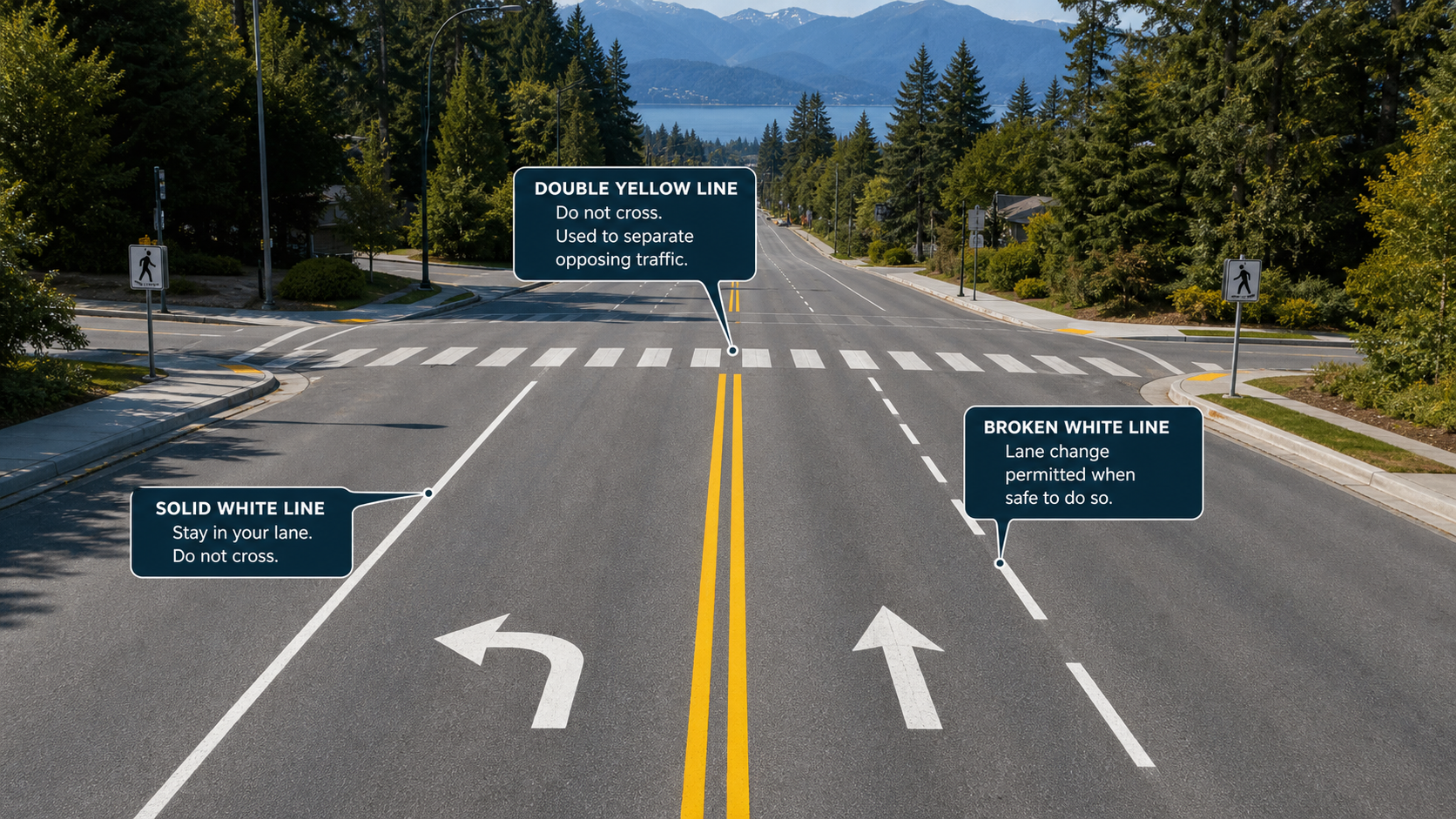
A solid white line usually separates lanes moving in the same direction and tells drivers that lane changes are discouraged or restricted. You may see solid white lines near intersections, crosswalks, merge areas, or places where changing lanes would create risk.
For the knowledge test, remember the safety idea: do not change lanes across a solid white line unless it is clearly permitted and safe.
Broken white lines
Broken white lines separate lanes moving in the same direction. They show that lane changes are allowed when it is safe. You still need to mirror check, shoulder check, signal, and make sure there is enough space.
Double yellow lines
Yellow lines separate traffic moving in opposite directions. Double yellow lines usually mean traffic is moving both ways and passing is restricted. Never treat a double yellow line like a normal lane divider.
Broken yellow lines
A broken yellow line can indicate that passing may be allowed when it is safe and legal. But "allowed" does not mean "always smart." You must consider visibility, oncoming traffic, road conditions, speed, and signs.
Stop lines
A stop line shows where your vehicle should stop at an intersection or stop sign. If there is no stop line, stop before the crosswalk. If there is no crosswalk, stop before entering the intersection where you can see traffic.
Crosswalk markings
Crosswalk markings show where pedestrians may cross. Drivers must be ready to stop for pedestrians in or approaching the crosswalk. On the knowledge test, pedestrian safety is usually the safest answer.
Lane arrows
Lane arrows show which direction traffic in that lane must go. If a lane has a left-turn arrow, do not use it to go straight. If a lane allows straight and right, follow the arrow and signal properly.
Bike lane markings
Bike lane markings show space reserved for cyclists. Drivers must check carefully before turning across a bike lane and must not drive in it except where legally permitted, such as entering or leaving a driveway or preparing for a turn where allowed.
Common test mistakes
Learners often miss road-marking questions because they focus only on signs. Study both together. A road sign may tell you a rule, while a road marking shows exactly where that rule applies.
Quick review
- White lines usually separate traffic moving in the same direction
- Yellow lines usually separate traffic moving in opposite directions
- Solid lines are more restrictive than broken lines
- Stop before the stop line
- Watch carefully for pedestrians at crosswalks
- Follow lane arrows before entering an intersection
Practice next
Review the BC road markings page, then take a road-sign and road-marking practice quiz. These questions are easy points if you study them directly.
Ready to pass your BC knowledge test?
Practice with 500+ real questions and mock exams.
Start Practicing Free